Science
In 1985, an amateur astronomer named Tim Hunter bought a plot of land outside Tucson to build a small observatory. He wasn't trying to start a movement. He just wanted somewhere dark enough to see what he'd paid for. Within a few years, a nearby hospital installed new outdoor lighting — unshielded, throwing light sideways and upward instead of down where anyone actually needed it — and Hunter's sky started disappearing again, this time from his own backyard.
He complained. He got nowhere. So he called an astronomer at Kitt Peak National Observatory named David Crawford, and the two of them started meeting to talk about what, if anything, could actually be done.
The physics is simple.
Light pollution isn't really about how much light a city has. It's more about where that light goes. A fixture that throws its beam downward, onto a sidewalk or a parking lot, does its job and stops. A fixture that's unshielded like the classic glowing globe on a pole, or a floodlight aimed sideways, sends a meaningful amount of its light straight up. Completely wasted, it has no job to do except to be scattered off dust and moisture in the atmosphere and wash out the sky for miles around. Two lights of identical wattage can have wildly different effects on a night sky, depending entirely on whether the fixture bothers to point the light at the ground.
This is the detail that made Crawford and Hunter's argument land where earlier complaints hadn't. They weren't asking anyone to turn lights off. They were asking for lights that pointed down.
Tucson had already tried this once.
Crawford had a mentor at Kitt Peak, an astronomer named Art Hoag, who in 1972 had helped pass the world's first lighting ordinance aimed at protecting a night sky. It was for Tucson, done over a decade before Crawford and Hunter ever met. It hadn't spread far. Most cities had no reason to think about it, and most lighting manufacturers had no reason to change what they made.
Crawford and Hunter incorporated the International Dark-Sky Association in Arizona in 1987, received nonprofit status in 1988, and spent the following years doing something unglamorous but effective. They talked to lighting manufacturers directly. By 1995, Astronomy magazine was reporting that manufacturers were finally producing shielded fixtures at scale — including a retrofit kit for the ubiquitous "cobra head" streetlight, of which more than 10 million hung on poles across the country. The cost was about $45 per fixture.
The organization goes by DarkSky International now, and its founders' basic argument hasn't changed: you don't need less light, you need better-aimed light.
Why cities glow at all.
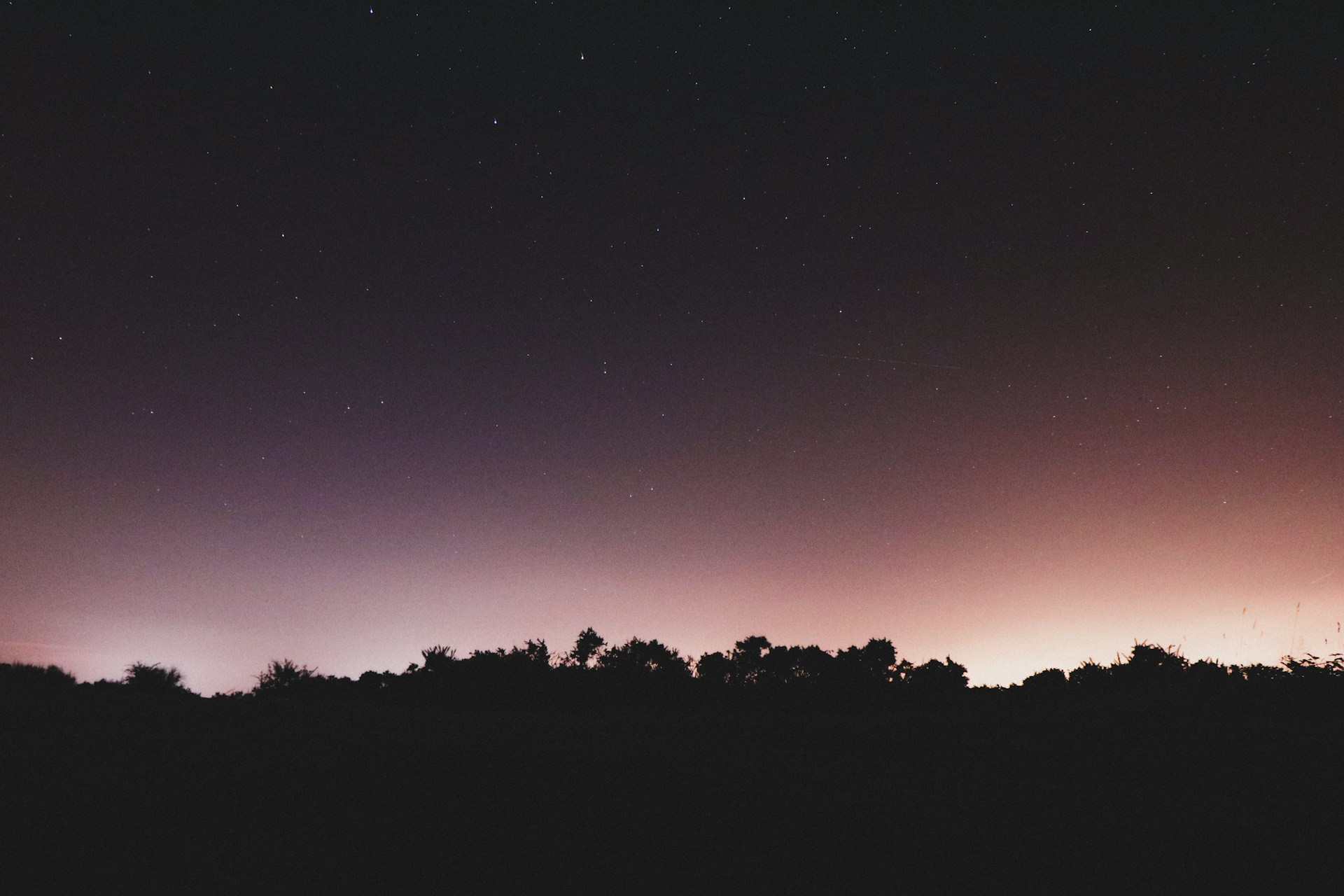
Skyglow, the dome of orange or white haze visible over any city from miles away, happens because light escaping upward doesn't just disappear into space. It scatters off water vapor, dust, and pollution particles in the atmosphere and bounces back down, diffused across the whole sky rather than concentrated where it started. This is also why humidity makes light pollution visibly worse on a hazy night than a dry one, and why desert climates with low humidity tend to hold their darkness better than a coastal city putting out the same raw amount of light.
The part that complicates the whole story.
Here's what nobody explains when they tell the shielding story: streetlights were never the main problem. When researchers actually measured where a city's light pollution comes from — using Tucson's own "smart" streetlight network to carefully dim and brighten it while satellites watched from orbit — they found streetlights account for only about 20% of the light escaping into space. The other 80% comes from parking lots, illuminated signs, garden lights, and building facades. Fix every streetlight in America and you've addressed a fifth of the actual problem.
That's a genuinely humbling finding for a movement that spent three decades focused heavily on municipal lighting. It's also the reason this fight was never going to be won by city ordinances alone — most of the light going up into the sky is coming from exactly the kind of fixture nobody regulates: the one on your own house.
Why "just switch to LED" isn't the whole answer either.
When Tucson finally converted roughly 18,000 streetlights to LED in 2016 and 2017, the result was a genuinely modest 7% reduction in measured skyglow — well under the 18 to 20% that models had predicted. The city got this right by being careful: a warm 3,000-Kelvin color temperature, and lumen output cut so aggressively that total light output after midnight dropped by more than 70%.
Los Angeles wasn't as careful. A comparable retrofit using cooler, 4,000-Kelvin LEDs actually increased sky glow by roughly 170% compared to the older sodium lights it replaced, lumen for lumen, because bluer, shorter-wavelength light scatters far more efficiently in the atmosphere than the amber glow of old sodium lighting. "Efficient" and "dark-sky friendly" turned out to be two completely different questions, and a lot of well-intentioned cities picked the wrong lightbulb color without realizing those were separate decisions.
What this has to do with where you're staying, and what's in your own yard.
It's part of why we weight shielded outdoor lighting so heavily when we're deciding whether a resort belongs in this directory — it's covered directly in our Dark Sky Index methodology. A property can sit in objectively dark territory and still undo most of the benefit with a few poorly aimed floodlights around the pool. The good ones, instead, treat the lighting plan itself as part of the design — decisions made once, at construction, that quietly pay off every single night afterward.
But given that most light pollution comes from exactly the kind of fixture almost nobody thinks to regulate, this is worth taking home with you too. The two things that actually matter, in order: choose a warm color temperature (3,000 Kelvin or lower, ideally closer to 2,700) over the brighter, bluer options that look more "modern" on a store shelf but do measurably more damage to the sky per lumen. And choose a genuinely shielded, fully cut-off fixture over an open one, which matters more than the bulb itself. We cover specific shielded, warm-temperature options in our gear guide, for anyone who wants their own porch light to actually be part of the solution instead of a small, personal contribution to the other 80%.
The same principle travels with you. A resort can do everything right with shielded lighting, a genuinely dark setting, and an astronomer who knows the sky but still lose it in an instant to one guest's unshielded white lantern or a phone flashlight left pointed at the wrong angle. The red-light headlamp we recommend for protecting your own eye adaptation does double duty here: it's also the considerate choice for whoever's standing next to you, trying to hold onto the same view you are.
The math on the country's cobra-head streetlights is a useful reminder of scale: light pollution isn't really a story about individual bad actors. It's a story about millions of small, fixable decisions, made mostly by people who'd never given the direction — or the color — of a light bulb a second thought, until an astronomer in Tucson refused to let his sky go quietly, and a satellite over Los Angeles proved the job still isn't finished.
The retrofit itself is almost anticlimactic once you see one: a simple metal shield or reflector added to an existing fixture, redirecting light that was already being paid for, already being generated, down toward the ground instead of wasted sideways and up. No new infrastructure, no reduction in actual visibility for the street below — just a redirect.
A single shielded, warm-toned fixture doesn't fix a sky on its own. Enough of them, on enough houses, genuinely can.
Written by Teresa Holden, founder of Stargazing Resorts.