Features
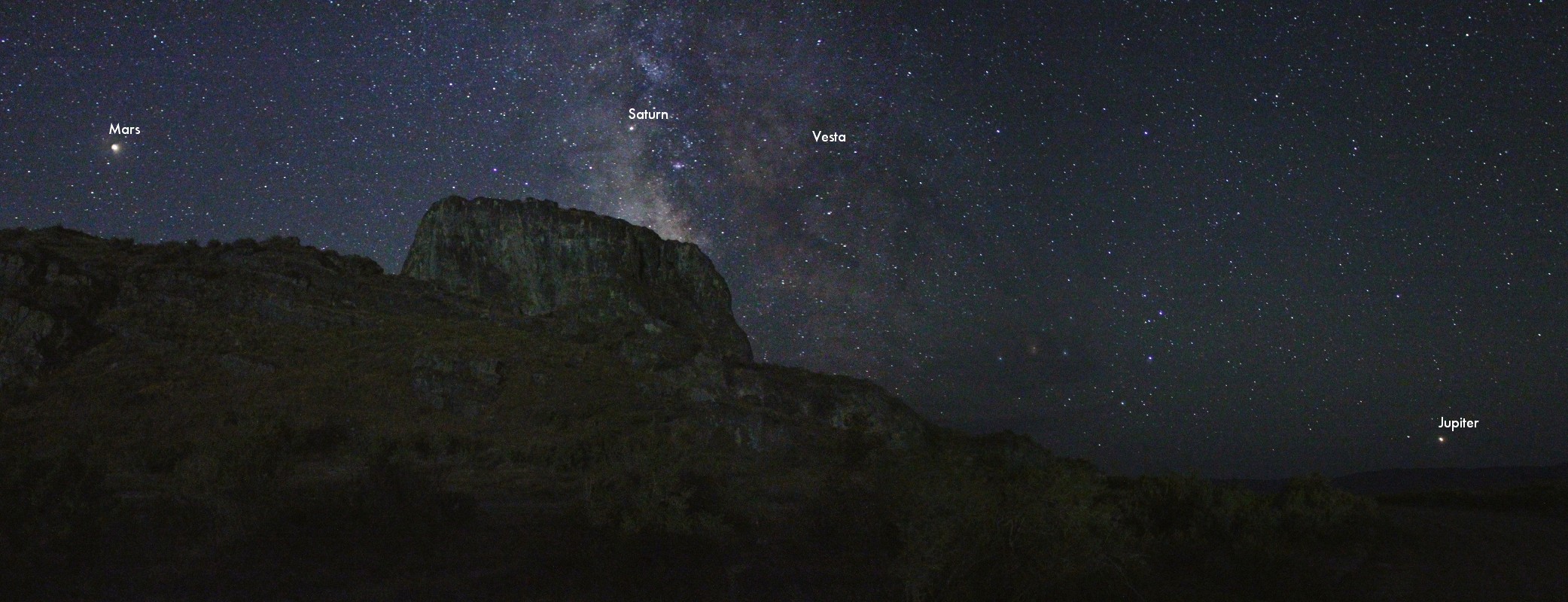
A few years ago I stood outside on an ordinary night and watched five planets line up across the sky at once — Mercury, Venus, Mars, Jupiter, Saturn, strung low along the horizon like something arranged on purpose. And for about five seconds, something shifted that I still struggle to describe. It wasn't that the sky looked pretty. It was that I suddenly, physically felt where I was — not looking up at a ceiling of lights, but standing on a tilted ball, inside a flat disk of orbiting things, looking out along its edge. My stomach lurched, the way it does at the top of a staircase you misjudge in the dark.
I've tried to describe that five seconds to people since, and I watch them do the thing people do when they don't know what to say back — the polite nod and quizzical smile. I don't think I'm describing it badly. I think it just doesn't survive translation. There's an old, well-worn line claiming that the people who were dancing were deemed insane by the people who could not hear the music. Not sure who said it first, but it's stuck around this long because it names something real. Some experiences only make sense when they happen to you.
It turns out I'm not the only one at a loss for words.
This April, an astronaut named Christina Koch had the same problem, live, on TV. She had spent years preparing for Artemis II. She studied very trajectory, every science objective, every simulation NASA could throw at her. Watching Earth rise over the Moon's far side, a quarter million miles from home, what she actually said was that nothing had prepared her for it. If the person whose entire job is knowing what's coming next in space still runs out of words for it, I stopped feeling embarrassed about running out of mine.
Then in August, a total solar eclipse crossed Iceland and Spain — the first to touch mainland Europe in nearly three decades. Hotel rooms in Reykjavík were packed. One passenger on a ship anchored off the coast described the mood the night before as “a little bit of a Christmas Eve feeling.” In rural Spain, people who had never given the sky a second thought stood in fields at sunset with borrowed glasses, waiting. None of them came home with an explanation. They came home with ninety seconds a camera can't actually capture.
Why the geometry actually does this to you.
There's a real reason a planet parade does what it does, and it's not mystical. Every planet orbits the sun on roughly the same flat plane. Most nights, you see them one at a time — a bright dot here, another there — so that shared plane stays an abstraction, something you'd only really understand from a diagram. A parade is the rare night that plane becomes visible edge-on, all at once, low across the horizon. For a few minutes, your body isn't looking up at a decorated ceiling anymore. It's registering, physically, that you're standing on a ball, inside a disk, looking out along its rim. That's not a metaphor. That's the literal geometry, momentarily made visible to a nervous system that almost never gets to feel it.
The stats are the easy part.
The numbers are exciting. 62 percent of travelers now say they're planning a trip to a dark sky destination. Separately, 67 percent say a stargazing or night-sky activity is going into their 2026 travel plans. In Western Australia, 89 percent of surveyed visitors said they'd travel specifically to see the stars. The whole category has a name now — noctourism — and a market size climbing toward $400 million by 2030.
Those numbers are useful for exactly one thing: proving you're not imagining the pull. You are not the only person who felt something shift this year. Not the only one standing in a backyard doing math on your own vertigo, not the only one watching an astronaut run out of words on live television, not the only one who stood in a Spanish field and went speechless with a few hundred strangers.
What the numbers can't do is tell you what it's actually like. Nothing can, including this article. A photo of a dark sky and the experience of standing under one are not the same. Not even close. The same way a diagram of the solar system and the feeling of suddenly sensing your place inside it aren't the same thing either.
We're not going to pretend.
We can't tell you what you'll feel the first time a sky goes properly dark and the Milky Way shows up. My first time left me and our entire group in silence. Nobody knew what to say. The experience is different for everyone and the ones who try hardest to explain it are usually the ones who trail off partway through. The same way Christina Koch did, a quarter million miles from anyone who could finish the sentence for her, and the same way I still do during the parade of planets.
What we can do is get you to the conditions where it has the best chance of happening to you. Help you pick the event, the location and how to plan accordingly. It is possible to find a truly sky dark that is also a comfortable place to view the universe. We might not be able to describe the feeling but we can help you experience it.
If this is the year you go.
You don't need an eclipse, or an astronaut's view, or a once-in-a-lifetime planetary lineup. You need one night, in one place, dark enough to work. The people flooding into this category right now didn't wait for permission — and neither did the crowd that stood in a Spanish field this August with borrowed glasses and no real idea what they were about to feel. They just went and looked up.
Written by Teresa Holden, founder of Stargazing Resorts.